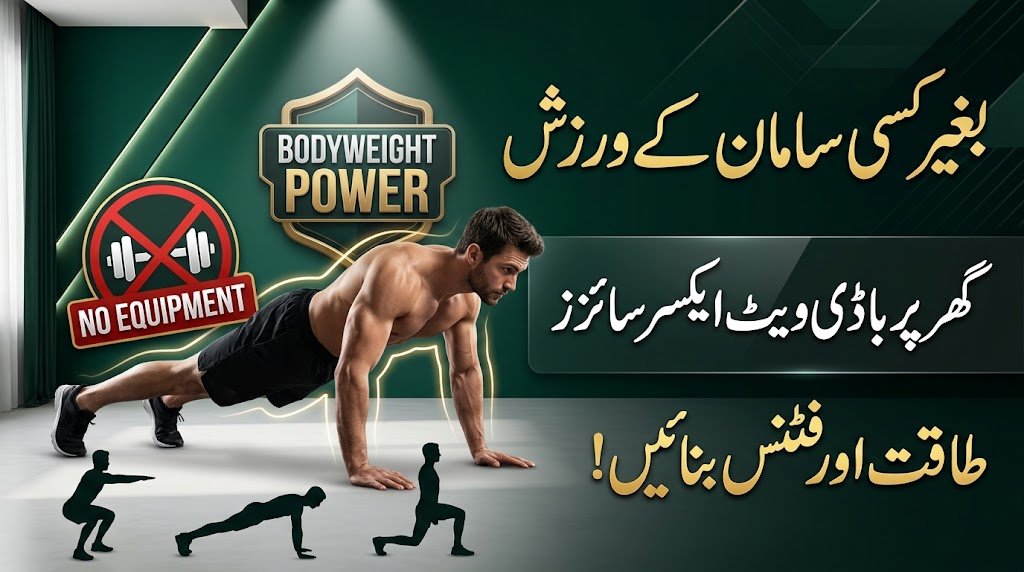
You don’t need a gym membership, expensive machines, or a room full of fitness equipment to start getting stronger.
A well-planned no-equipment home workout can use your own body weight as resistance while targeting major muscle groups through movements such as squats, push-ups, lunges, planks and glute bridges.
Bodyweight training is not merely a convenient alternative for busy days. Current guidance from the American College of Sports Medicine recognizes bodyweight and home-based resistance training as effective options, while emphasizing gradual progression and consistency.
The key is not doing hundreds of random repetitions. It is choosing useful movements, performing them with good technique, recovering properly and gradually making the exercises more challenging.
Quick Full-Body Bodyweight Workout
If you want a simple routine to start today, try this sequence:
| Exercise | Beginner Target | Main Focus |
|---|---|---|
| Bodyweight Squat | 8–12 reps | Legs & glutes |
| Push-Up | 5–12 reps | Chest, shoulders & arms |
| Reverse Lunge | 6–10 each leg | Legs & balance |
| Glute Bridge | 10–15 reps | Glutes & hips |
| Plank | 15–30 sec | Core |
| Bird Dog | 6–10 each side | Core & stability |
| Mountain Climber | 15–30 sec | Full body & conditioning |
Beginner: 1–2 rounds
Intermediate: 2–3 rounds
Rest: About 30–90 seconds between exercises as needed
Don’t worry about matching someone else’s numbers. Your starting point should be based on your current ability.
Why Choose a No-Equipment Workout?
The biggest advantage is accessibility.
You can exercise in a bedroom, living room, hotel room, office or another suitable space without setting up a home gym.
1. It costs almost nothing
Your body provides the resistance, so there is no requirement for dumbbells, barbells or exercise machines.
2. It is easy to fit into a busy schedule
A short workout can be much easier to maintain than a complicated routine requiring travel to a gym.
3. It can train several movement patterns
Squats train the lower body, pushing movements challenge the upper body, while planks and similar exercises develop trunk control.
4. You can scale many exercises
A push-up can be made easier by using an elevated surface or harder through more demanding variations.
5. Consistency becomes easier
The best routine is one you can realistically perform over time. ACSM’s updated resistance-training guidance emphasizes choosing a program that fits your schedule and goals rather than assuming that complicated training is automatically better.
Best Bodyweight Exercises for Strength & Fitness
1. Bodyweight Squats
The squat is one of the most practical lower-body exercises for a home workout.
How to perform it:
- Stand with your feet around shoulder-width apart.
- Keep your chest comfortably lifted.
- Bend your knees and hips while lowering under control.
- Keep your feet planted.
- Push through your feet to return to standing.
Beginner option: Use a chair as a depth reference.
Progression: Try pause squats or slower repetitions once standard squats become comfortable.
2. Push-Ups
Push-ups are a classic upper-body bodyweight movement that primarily challenges the chest, shoulders and triceps while requiring core stability.
Basic technique:
- Place your hands slightly wider than shoulder width.
- Keep your body in a controlled line.
- Lower your chest toward the floor.
- Push away without rushing the movement.
Can’t Do a Full Push-Up Yet?
Start with an easier variation rather than forcing poor technique.
Try:
Wall push-up → elevated push-up → knee push-up → standard push-up
Choose the version that allows controlled repetitions.
3. Reverse Lunges
Lunges add a single-leg component to your home workout.
Stand tall, step one foot backward and lower yourself under control. Push through the front foot to return to the starting position, then switch sides.
Reverse lunges can be particularly useful for people who find forward lunges uncomfortable or difficult to control.
Beginner target: 6–10 repetitions per side.
4. Glute Bridges
Glute bridges are a simple floor-based movement for the posterior chain, particularly the glutes.
Lie on your back with your knees bent and feet positioned comfortably on the floor.
Then:
- Brace your midsection gently.
- Press through your feet.
- Raise your hips.
- Pause briefly at the top.
- Lower with control.
Avoid turning the movement into an exaggerated lower-back arch.
5. Plank
A plank trains your ability to maintain a stable trunk while supporting your body.
Start with a short hold instead of chasing a long duration.
For example:
15 seconds × 2–3 sets
As your control improves, gradually increase the duration.
Quality matters more than simply surviving a long hold.
6. Bird Dog
This controlled movement combines core stability with coordination.
Begin on your hands and knees. Extend the opposite arm and leg while keeping your torso stable, then return to the starting position and switch sides.
Move slowly.
If your hips rotate dramatically, reduce the range of motion until you can control the exercise.
7. Mountain Climbers
Mountain climbers can add a more dynamic component to a bodyweight routine.
From a high-plank position, bring one knee toward your torso and return it before alternating sides.
Beginners can perform the movement slowly.
More experienced exercisers can increase the pace while maintaining good body control.
A 20-Minute No-Equipment Home Workout
You can organize the exercises into a simple circuit.
Warm-Up — 3 to 5 Minutes
Use gentle movements such as:
- Marching in place
- Arm circles
- Controlled bodyweight squats
- Easy step-ups if you have a safe surface
- Gentle mobility movements
Main Circuit
Perform:
10 squats
6–12 push-ups
8 reverse lunges per side
12 glute bridges
20-second plank
8 bird dogs per side
Rest after completing the circuit.
Repeat 1–3 rounds, depending on your fitness level and available time.
Finish with a few minutes of easy movement rather than immediately stopping after intense exercise.
ACSM guidance emphasizes appropriate warm-up and cool-down, along with prioritizing exercise technique for safety.
Beginner No-Equipment Workout Plan
If you’re completely new to exercise, don’t begin with an advanced seven-day challenge.
A simple weekly structure may be easier to maintain:
| Day | Activity |
|---|---|
| Monday | Full-body bodyweight workout |
| Tuesday | Walking or light activity |
| Wednesday | Full-body workout |
| Thursday | Recovery or easy movement |
| Friday | Full-body workout |
| Saturday | Walking, mobility or recreational activity |
| Sunday | Rest |
You can reduce the number of sessions if your body needs more recovery.
For adults, WHO recommends muscle-strengthening activities involving major muscle groups on at least two days per week, alongside regular aerobic physical activity.
How to Make Bodyweight Exercises Harder
One of the biggest mistakes in home training is assuming that progress requires more and more repetitions.
Instead, you can change the difficulty of the movement.
Try these progression methods:
Increase repetitions
Move from 8 controlled repetitions toward 10 or 12.
Add another set
For example, progress from two sets to three.
Slow the movement
A controlled lowering phase can make a familiar exercise more demanding.
Add pauses
Pause briefly at the hardest point of a squat or push-up.
Use a harder variation
Progress from a regular squat to a split squat or another appropriate variation.
Improve your range of motion
Only increase range when you can maintain good control.
ACSM’s current resistance-training guidance recommends progressively challenging the body while tailoring training volume and intensity to individual goals.
How Many Bodyweight Exercises Should You Do?
More is not automatically better.
A balanced routine can cover several major movement patterns:
- Squat: bodyweight squat
- Single-leg: reverse lunge
- Push: push-up
- Hip-focused: glute bridge
- Core stability: plank or bird dog
- Dynamic conditioning: mountain climber
This gives you a practical starting framework without turning a short home session into an unnecessarily complicated program.
Can You Build Strength Without Weights?
Yes.
Bodyweight exercises can provide meaningful resistance, particularly when the movement is appropriately challenging.
ACSM’s 2026 resistance-training guidance specifically notes that traditional gym environments are not required for results and that bodyweight and home-based training can improve strength, hypertrophy and physical function.
However, the difficulty of bodyweight training depends on the exercise.
A beginner may find a standard push-up highly challenging, while an experienced trainee may eventually need a more difficult variation to continue progressing.
That’s why progressive overload does not always mean adding weight.
With bodyweight training, progression can come from changing leverage, range of motion, tempo, repetitions, sets or exercise variation.
How Often Should You Do a Home Strength Workout?
For general health, WHO recommends muscle-strengthening activities involving major muscle groups at least two days per week for adults.
That doesn’t mean everyone needs the same schedule.
Someone starting from zero may benefit from fewer sessions initially, while a more experienced person may tolerate a greater training frequency.
A useful rule is:
Start with a manageable workload, recover, then gradually build.
Your routine should fit your current fitness, schedule and recovery capacity.
Common Home Workout Mistakes to Avoid
Doing Too Much Too Soon
Starting with an extremely difficult challenge can leave you exhausted and make consistency harder.
Ignoring Technique
Fast repetitions aren’t useful if you cannot control the movement.
Training Only One Body Part
Doing dozens of push-ups while ignoring the legs and core creates an incomplete routine.
Never Progressing
If the same exercise becomes extremely easy, gradually increase the challenge.
Skipping Recovery
Your training plan should include recovery days and sensible workload management.
Chasing Soreness
Being extremely sore is not a reliable measure of whether a workout was successful.
A Smarter Way to Track Progress
You don’t need an expensive fitness tracker.
Keep a simple note on your phone.
Record:
Exercise: Push-up
Week 1: 6 reps
Week 2: 8 reps
Week 3: 9 reps
Week 4: 10 reps
You can track repetitions, sets, exercise variations and how difficult each session felt.
ACSM specifically recommends keeping track of progress as part of effective resistance exercise.
Small improvements accumulated over several weeks can be more useful than constantly changing your workout.
No-Equipment Workout for Small Spaces
You don’t need a large room.
For a compact routine, choose exercises that require little movement around the room:
- Squats
- Push-ups
- Glute bridges
- Bird dogs
- Planks
- Reverse lunges
- Mountain climbers
Clear the floor of objects that could cause you to trip, and make sure you have enough room to move safely.
Is a 10-Minute Home Workout Worth Doing?
Absolutely—especially when the alternative is doing nothing.
A short session can help you establish consistency and accumulate physical activity.
The important distinction is that a 10-minute workout should not be presented as a magical replacement for all physical activity.
WHO recommends adults accumulate 150–300 minutes of moderate-intensity aerobic activity per week, or the vigorous equivalent, along with muscle-strengthening activity on at least two days.
Think of a short workout as one useful part of an active lifestyle.
Safety Tips Before Starting
Bodyweight exercise is accessible, but it still requires sensible preparation.
- Start at an appropriate difficulty.
- Warm up before demanding movements.
- Prioritize controlled technique.
- Don’t hold your breath unnecessarily.
- Stop if you experience unusual or severe pain.
- Use a stable surface.
- Give your body time to recover.
- Increase difficulty gradually.
If you have an injury, medical condition, significant pain or another health concern that could affect exercise, consider getting individualized advice from an appropriately qualified healthcare professional before starting a new training program.
Frequently Asked Questions
What is the best no-equipment home workout?
There isn’t one universal routine that is best for everyone. A useful full-body workout can combine squats, push-ups, lunges, glute bridges and core exercises, then progress according to your ability.
Can I get stronger with only bodyweight exercises?
Yes. Bodyweight exercises can provide effective resistance, and current ACSM guidance recognizes home-based and bodyweight resistance training as effective options.
How many days a week should I do bodyweight exercises?
For general health, adults should perform muscle-strengthening activities involving major muscle groups at least two days per week.
Are bodyweight exercises good for beginners?
Yes. Many bodyweight exercises can be modified to match a beginner’s current ability. Start with easier variations and increase difficulty gradually.
Can home workouts help with fitness?
Yes. A properly structured home routine can contribute to strength, muscular endurance and overall physical activity. Aerobic activity should also be included as part of a balanced fitness routine.
How long should a home workout last?
There is no single required duration. A short session can be useful, while longer sessions may allow more exercises or sets. Your available time, fitness level and goals should determine the workout length.
Do I need equipment to build muscle?
Not necessarily. Bodyweight training can stimulate the muscles effectively, although the type and amount of resistance you can create will depend on your exercise selection and training level.
What should I do if regular push-ups are too difficult?
Use a progression such as wall push-ups or elevated push-ups, then gradually work toward floor push-ups as your strength and control improve.
The Bottom Line
A no-equipment home workout can be remarkably simple.
You don’t need a complicated exercise library or expensive equipment to begin. Start with foundational movements such as squats, push-ups, lunges, glute bridges and planks, learn the correct technique and gradually increase the challenge.
The most effective home workout is ultimately one you can perform consistently.
Rather than searching for a secret exercise that produces instant results, build a routine that fits your life, track your progress and make small improvements over time. Current evidence and professional guidance support bodyweight and home-based resistance exercise as legitimate ways to train without relying on a traditional gym.