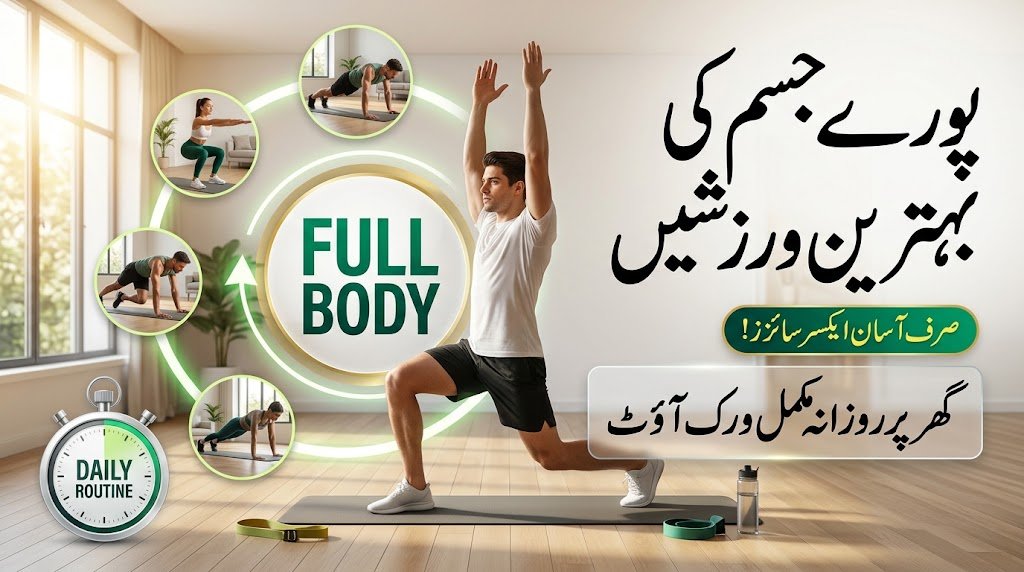
Staying active does not always require a gym membership or expensive equipment. A simple home workout can target your legs, arms, chest, shoulders, back, and core while helping you build strength and improve overall fitness.
The best part is that many full-body exercises at home require little or no equipment. With a few basic movements and a consistent routine, beginners can create an effective daily workout that fits into a busy schedule.
This guide explains some of the best full-body exercises to do at home, how to perform them safely, and how to combine them into a simple workout routine.
What Is a Full-Body Workout?
A full-body workout includes exercises that involve several major muscle groups during the same session. Instead of focusing only on the arms or legs, these movements allow you to work different parts of your body together.
A balanced home routine can include:
- Lower-body exercises
- Upper-body movements
- Core exercises
- Bodyweight strength exercises
- Light cardio movements
- Mobility and stretching
You can adjust the number of repetitions, rest periods, and exercise difficulty according to your fitness level.
Best Full-Body Exercises at Home
Here are practical bodyweight exercises that can form the foundation of a home fitness routine.
1. Bodyweight Squats


Squats are one of the easiest ways to train the lower body without equipment. They primarily work the thighs and glutes while also requiring your core to stabilize your body.
How to do them:
- Stand with your feet approximately shoulder-width apart.
- Keep your chest lifted and your back in a comfortable neutral position.
- Bend your knees and push your hips backward.
- Lower yourself as far as comfortable while keeping your heels on the floor.
- Press through your feet to return to the starting position.
Beginner target: 8–12 repetitions.
2. Push-Ups


Push-ups are a classic bodyweight movement for the chest, shoulders, arms, and core.
If a standard push-up is difficult, start with your hands on a sturdy elevated surface or perform the movement from your knees.
How to do them:
- Place your hands slightly wider than your shoulders.
- Keep your body controlled as you lower your chest.
- Avoid allowing your hips to sag.
- Push yourself back up without rushing.
Beginner target: 5–10 repetitions.
3. Reverse Lunges


Reverse lunges train the legs and glutes while challenging your balance and coordination.
Stepping backward can also make the movement easier to control than some forward-lunge variations.
How to perform a reverse lunge:
- Stand upright with your feet comfortably apart.
- Step one foot backward.
- Bend both knees in a controlled manner.
- Keep your front foot stable.
- Push through the front foot to return to standing.
- Repeat on the opposite side.
Try 6–10 repetitions per leg when starting.
4. Glute Bridges


Glute bridges are performed on the floor and focus on the glutes and muscles around the hips.
They are particularly convenient for people who want a low-impact movement in their home exercise routine.
Steps:
- Lie on your back with your knees bent.
- Place your feet flat on the floor.
- Keep your arms beside your body.
- Raise your hips while maintaining control.
- Pause briefly at the top.
- Lower your hips slowly.
Complete 10–15 repetitions.
5. Plank


The plank is an isometric exercise that challenges the core and requires your body to remain stable.
Rather than trying to hold the position for as long as possible, beginners should focus on maintaining good form.
How to hold a plank:
- Place your forearms on the floor.
- Extend your legs behind you.
- Keep your body in a straight, controlled line.
- Brace your abdominal muscles.
- Breathe normally instead of holding your breath.
Start with 15–30 seconds and gradually increase the duration as your control improves.
6. Mountain Climbers


Mountain climbers combine a plank position with alternating leg movement. They can raise your heart rate while challenging your core and lower body.
For beginners, move slowly and prioritize control rather than speed.
Try 15–30 seconds to begin.
7. Bird-Dog


Bird-dogs are a useful bodyweight movement for practicing balance, coordination, and controlled core stability.
How to perform the exercise:
- Begin on your hands and knees.
- Extend one arm and the opposite leg.
- Keep your torso as steady as possible.
- Return to the starting position.
- Switch sides.
Perform 6–10 controlled repetitions per side.
8. Standing Calf Raises
Calf raises are simple enough to perform almost anywhere in your home.
Stand upright, slowly raise your heels, pause briefly, and lower them with control.
Try 12–20 repetitions.
9. Wall Sit


A wall sit is a straightforward lower-body exercise that requires only a clear wall.
Lean your back against the wall and slide downward into a comfortable position. Keep your feet firmly planted and hold the position while maintaining controlled breathing.
Beginners can start with 15–30 seconds.
10. Jumping Jacks


Jumping jacks are a convenient cardio movement that can be used during a warm-up or between strength exercises.
If jumping is uncomfortable, perform a low-impact variation by stepping one foot out at a time instead.
Start with 20–30 seconds.
Simple Full-Body Workout Routine for Every Day
You do not need to perform every exercise in one session. A balanced beginner workout can be short and manageable.
20-Minute Beginner Home Workout
| Exercise | Repetitions/Time |
|---|---|
| Jumping jacks | 30 seconds |
| Bodyweight squats | 10 reps |
| Push-ups | 5–10 reps |
| Reverse lunges | 6–8 each leg |
| Glute bridges | 12 reps |
| Bird-dog | 6 each side |
| Plank | 20 seconds |
| Calf raises | 15 reps |
Rest for around 30–60 seconds between movements when needed.
If the routine feels too difficult, reduce the repetitions. If it becomes easy, gradually increase the workload rather than making a large jump in intensity.
How to Structure a Daily Home Workout
A simple session can follow this pattern:
1. Warm up — 3 to 5 minutes
Start with gentle movements such as walking around the room, arm circles, easy marching, and light mobility exercises.
2. Strength work — 10 to 15 minutes
Choose several exercises that cover the upper body, lower body, and core.
3. Optional cardio — 3 to 5 minutes
Use jumping jacks, marching, step-ups, or another suitable movement.
4. Cool down
Finish with gentle movement and relaxed stretching.
This structure is more practical for beginners than trying to complete a long workout immediately.
Full-Body Workout for Beginners Without Equipment
If you have no dumbbells, resistance bands, or machines, bodyweight training can still provide a useful starting point.
Try this circuit:
Round 1
- 10 squats
- 5 push-ups
- 8 reverse lunges per leg
- 12 glute bridges
- 20-second plank
Rest for 60–90 seconds.
Repeat for 2–3 rounds, depending on your fitness level.
The goal is not to finish as quickly as possible. Controlled repetitions and consistent technique are more important than rushing through the circuit.
How Often Should You Do Full-Body Exercises?
How often you exercise depends on your fitness level, workout intensity, recovery, and overall activity.
Although light movement can be incorporated into everyday life, you do not need to perform a hard full-body strength session every day.
A beginner-friendly approach is to alternate harder workouts with easier movement days.
Example Weekly Schedule
Monday: Full-body workout
Tuesday: Walking or light mobility
Wednesday: Full-body workout
Thursday: Easy activity or rest
Friday: Full-body workout
Saturday: Light cardio or recreational activity
Sunday: Rest or gentle movement
This gives your body opportunities to recover while keeping you active throughout the week.
How to Make Home Workouts More Effective
You can improve your routine without buying expensive equipment.
Focus on Technique
Learn the movement before increasing repetitions. Poor technique can reduce the quality of an exercise and may increase the chance of discomfort or injury.
Progress Gradually
When an exercise becomes easier, increase one variable at a time:
- Add a few repetitions.
- Increase the duration slightly.
- Add another round.
- Use a more challenging variation.
- Reduce rest modestly.
Keep Your Routine Consistent
A short workout that you perform regularly can be more practical than an ambitious routine that you quickly abandon.
Choose a schedule that fits your lifestyle.
Track Your Progress
Write down your repetitions, workout duration, or number of completed rounds. Seeing gradual improvement can help you stay motivated.
Low-Impact Alternatives for Beginners
Not everyone needs jumping movements to get a useful workout.
Replace jumping jacks with marching in place. Replace fast mountain climbers with slow alternating knee drives. For squats, use a chair as a reference point if you need additional confidence.
The best exercise is one you can perform safely and consistently.
Common Home Workout Mistakes to Avoid
Even simple exercises can become less effective when performed carelessly.
Doing Too Much Too Soon
Starting with an extremely demanding routine can leave you excessively fatigued and make it harder to maintain consistency.
Ignoring Warm-Up
A few minutes of gentle movement can help prepare your body for the session.
Sacrificing Form for Repetitions
Ten controlled repetitions are generally more useful than rushing through twenty repetitions with poor technique.
Training Through Sharp Pain
Normal muscular effort is different from sharp or unusual pain. Stop an exercise if something feels wrong and seek appropriate professional advice when necessary.
Forgetting Recovery
Your fitness routine should include adequate rest, sleep, nutrition, and easier days.
Can You Build Strength With Home Exercises?
Yes. Bodyweight exercises can challenge your muscles, especially when you progressively increase the difficulty.
Beginners may notice improvements in strength and movement control from consistent training. As you become stronger, exercises can be modified to provide a greater challenge.
For example:
Squat → Pause squat → Split squat
Incline push-up → Knee push-up → Standard push-up
Short plank → Longer plank → More challenging plank variation
Progression does not always mean doing hundreds of repetitions.
What Should You Do Before a Home Workout?
Before exercising, prepare a safe space and remove objects that could cause you to trip.
Wear comfortable clothing and choose footwear appropriate for the surface and activity. Begin with several minutes of gentle movement rather than immediately starting at maximum effort.
If you have an existing medical condition, injury, or specific exercise concern, consider discussing your planned activity with a qualified healthcare professional.
Frequently Asked Questions
What is the best full-body exercise at home?
There is no single exercise that is best for everyone. Squats, push-ups, lunges, glute bridges, planks, and other bodyweight movements can be combined to train different areas of the body.
Can I do a full-body workout at home without equipment?
Yes. A variety of bodyweight movements can be performed without gym machines or weights.
How long should a home workout be?
A beginner session can be relatively short. Even 15–20 minutes can provide a practical starting point, depending on the exercises and your fitness level.
Is it okay to exercise every day?
Light activity can be part of everyday life, but demanding full-body strength sessions do not necessarily need to be performed daily. Recovery should be part of your overall routine.
What exercises should beginners start with?
Beginners can start with manageable movements such as squats, incline push-ups, glute bridges, bird-dogs, calf raises, and short planks before progressing to more demanding variations.
How can I stay consistent with home workouts?
Set a realistic schedule, keep workouts manageable, track your progress, and choose exercises you enjoy. Building a routine that fits your daily life is often easier to maintain than relying on motivation alone.
Final Takeaway
A complete home workout does not have to be complicated. Bodyweight squats, push-ups, reverse lunges, glute bridges, planks, bird-dogs, calf raises, and simple cardio movements can create a balanced routine without requiring a gym.
Start at a comfortable level, learn proper technique, increase the challenge gradually, and give your body enough time to recover. The most useful home workout routine is one that is safe, realistic, and sustainable.