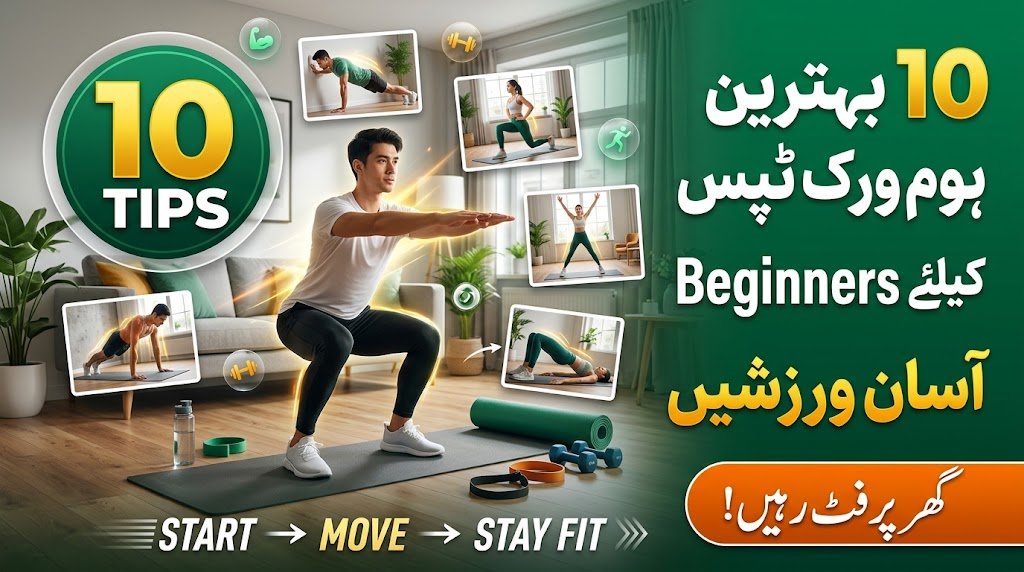
Starting a fitness routine does not always require a gym membership, expensive equipment, or complicated training plans. For beginners, some of the most useful exercises can be performed at home with little or no equipment.
The key is to begin at a comfortable level, learn proper movement, stay consistent, and gradually increase activity as your fitness improves.
This guide covers 10 practical home workout tips for beginners, along with simple exercises that can help improve strength, mobility, balance, and overall fitness.
Quick Answer: What Is the Best Home Workout for Beginners?
A good beginner home workout combines simple strength exercises, light cardio, mobility work, and adequate recovery.
A basic session can include:
- Marching in place
- Bodyweight squats
- Wall or knee push-ups
- Glute bridges
- Bird-dogs
- Standing knee raises
- Step-ups
- Planks
- Light stretching
- A short cool-down
You do not need to perform every exercise in one session. The best routine is one that matches your current fitness level and that you can maintain consistently.
For adults, the World Health Organization recommends at least 150 minutes of moderate-intensity physical activity per week, or 75 minutes of vigorous activity, with muscle-strengthening activities involving major muscle groups on at least two days each week.
1. Start With a Short Workout
One of the biggest mistakes beginners make is trying to do too much on the first day.
A 15- to 20-minute workout can be a much better starting point than an intense hour-long session that leaves you exhausted.
Begin with manageable activity and increase the duration gradually.
Simple beginner approach
Try:
- 3–5 minutes of gentle warm-up
- 10–15 minutes of basic exercises
- 3–5 minutes of cool-down
As your fitness improves, you can gradually increase your workout time.
Consistency matters more than starting with maximum intensity.
2. Warm Up Before Exercising
A warm-up prepares your body for movement and gives you an opportunity to gradually increase your activity level.
You can warm up at home without equipment.
Easy warm-up movements
- Walk around the room
- March in place
- Move your arms gently
- Perform controlled shoulder circles
- Do slow bodyweight squats
- Gently move your ankles and hips
Spend several minutes warming up before more demanding movements.
The goal is not to tire yourself out. It is simply to prepare your body for the workout.
3. Practice Bodyweight Squats
Bodyweight squats are one of the simplest exercises beginners can learn at home.
They primarily work the muscles of the lower body while also requiring your core to help stabilize your movement.
How to perform a basic squat
- Stand with your feet around shoulder-width apart.
- Keep your chest comfortably upright.
- Bend your knees and hips as if sitting toward a chair.
- Lower yourself only as far as you can comfortably control.
- Push through your feet to return to standing.
Beginners can start with a small number of controlled repetitions rather than trying to complete a large set.
If balance is difficult, perform the movement near a sturdy support.
4. Try Wall Push-Ups
Traditional push-ups can be challenging for someone who is completely new to exercise.
Wall push-ups offer a simpler variation.
Stand facing a wall, place your hands against it, and slowly bend your elbows to bring your upper body toward the wall. Then press yourself back to the starting position.
This movement can help beginners become familiar with the pushing pattern before progressing to more difficult variations.
Beginner progression
You can gradually move from:
Wall push-ups → incline push-ups → knee push-ups → standard push-ups
There is no need to rush through these stages.
Focus on controlled movement and good technique.
5. Add Glute Bridges
Glute bridges are a convenient floor exercise that targets the muscles around the hips and buttocks.
Basic technique
Lie on your back with your knees bent and feet positioned on the floor.
Keep your upper body relaxed while gently lifting your hips. Pause briefly at the top, then lower them under control.
Avoid turning the exercise into a fast, bouncing movement.
A slower and controlled repetition is generally more useful for learning the movement.
6. Use Marching for Simple Cardio
You do not need a treadmill or exercise bike to add cardiovascular movement to a home workout.
Marching in place is a beginner-friendly option.
Lift one foot at a time while moving your arms naturally. You can increase the pace slightly when you become comfortable.
Other simple home cardio options include:
- Walking around your home
- Step-ups on a safe, stable step
- Low-impact side steps
- Dancing
- Light jogging in place, if appropriate for your fitness level
Choose an activity that you can perform safely and continuously.
7. Strengthen Your Core With Bird-Dogs
The bird-dog is a useful beginner movement for practicing balance, coordination, and controlled trunk stability.
Start on your hands and knees.
Slowly extend one arm and the opposite leg while keeping your body stable. Return to the starting position and repeat on the other side.
The important part is control.
Do not try to lift your arm and leg as high as possible. Instead, concentrate on keeping your torso steady throughout the movement.
8. Don’t Ignore Mobility and Stretching
A home workout should not be limited to strength and cardio.
Mobility work and gentle stretching can also help make movement feel more comfortable.
After exercising, you can include easy stretches for areas such as:
- Shoulders
- Chest
- Hips
- Hamstrings
- Calves
- Back
Move gradually and avoid forcing a stretch.
If a movement causes sharp or unusual pain, stop rather than attempting to push through it.
9. Increase Difficulty Gradually
Progress does not necessarily mean doing harder exercises immediately.
Beginners can make a workout more challenging in several ways.
For example, you might:
- Add a few repetitions
- Increase the workout duration
- Add another set
- Reduce rest slightly
- Improve movement control
- Progress to a more challenging exercise variation
Only change one or two factors at a time.
A gradual approach makes it easier to understand how your body responds to increased activity.
WHO guidance also emphasizes that people who are currently inactive can start with small amounts of activity and gradually increase duration, frequency, and intensity.
10. Make Consistency Your Main Goal
The most effective beginner workout is not necessarily the hardest one.
It is the routine you can continue.
Instead of thinking about exercise as something you must do perfectly, treat physical activity as part of your regular lifestyle.
A simple weekly routine might look like this:
| Day | Beginner Activity |
|---|---|
| Monday | Full-body home workout |
| Tuesday | Walking or light cardio |
| Wednesday | Rest or gentle mobility |
| Thursday | Full-body home workout |
| Friday | Light cardio |
| Saturday | Short strength session or active recreation |
| Sunday | Rest and recovery |
This is only an example. Your schedule can be adjusted according to your current activity level, goals, and available time.
A Simple 20-Minute Beginner Home Workout
If you want a straightforward routine, try this structure:
Warm-up — 3 minutes
- March in place
- Arm movements
- Gentle bodyweight movements
Main workout — about 12 minutes
Perform the following exercises at a comfortable pace:
- Bodyweight squats
- Wall push-ups
- Glute bridges
- Bird-dogs
- Marching in place
- A beginner-friendly plank variation
Take short breaks whenever necessary.
Cool-down — 5 minutes
Finish with slow walking and gentle stretching.
You can adjust the duration depending on your fitness level.
How Many Days a Week Should a Beginner Exercise?
There is no single schedule that works for everyone.
A beginner can focus first on establishing a regular pattern of movement.
For general adult health, WHO recommends 150–300 minutes of moderate-intensity aerobic activity per week, or an equivalent combination of moderate and vigorous activity. It also recommends muscle-strengthening activity involving major muscle groups on at least two days per week.
Someone who is currently inactive does not have to reach the full target immediately.
Starting with shorter sessions and building gradually can be a practical way to become more active.
Can You Get Fit at Home Without Equipment?
Yes.
Many useful exercises rely on bodyweight rather than gym machines.
Examples include:
- Squats
- Wall push-ups
- Lunges or supported lunges
- Glute bridges
- Bird-dogs
- Planks
- Marching
- Step-ups
- Mobility exercises
Household space can be enough for a basic fitness routine.
Equipment can be added later if you want more exercise variety, but it is not essential for beginning regular physical activity.
Beginner Workout Mistakes to Avoid
Starting a new routine is easier when you know what to avoid.
Doing too much too soon
An extremely difficult first workout is not necessary.
Ignoring technique
A controlled movement is more useful than rushing through repetitions.
Skipping warm-up and cool-down
A few minutes of preparation and gradual recovery can make the session more comfortable.
Comparing yourself with experienced exercisers
Fitness levels differ considerably. Your starting point does not need to look like someone else’s.
Training every day without recovery
Rest and lighter activity can be part of a balanced routine.
Expecting instant results
Fitness develops through repeated effort over time.
How to Stay Motivated With Home Workouts
Motivation can disappear quickly if every workout feels like a major task.
Instead, make exercise easier to start.
Keep your workout clothes ready, choose a convenient time, and decide in advance what exercises you will perform.
You can also track simple milestones such as:
- Number of workout sessions completed
- Total active minutes
- Repetitions performed comfortably
- Walking time
- How consistently you followed your routine
The goal is to measure progress rather than perfection.
Home Workout Tips for Weight Management
Exercise can contribute to an active lifestyle, but body weight is influenced by multiple factors.
A sustainable approach combines regular movement with balanced nutrition, adequate sleep, and realistic long-term habits.
Avoid promises such as “lose a specific number of kilograms in a few days.” Results vary from person to person.
For beginners, the more useful objective is to build a routine that can be maintained over time.
Easy Home Exercises for Different Fitness Levels
Not everyone begins at the same level.
If you are completely new
Try:
- Walking
- Marching in place
- Wall push-ups
- Supported squats
- Gentle mobility exercises
If basic exercises feel comfortable
You can introduce:
- Bodyweight squats
- Incline push-ups
- Glute bridges
- Step-ups
- Bird-dogs
- Longer cardio sessions
If you already have some experience
You may gradually explore:
- Standard push-ups
- Lunges
- Longer planks
- More demanding cardio
- Structured full-body circuits
Progress should be based on your ability rather than a fixed timetable.
A Practical Beginner Fitness Checklist
Before each session, ask yourself:
- Do I have enough space to move safely?
- Have I warmed up?
- Am I using controlled movements?
- Can I breathe comfortably?
- Am I taking breaks when needed?
- Is the exercise appropriate for my current ability?
- Have I planned time for recovery?
This simple checklist can make a home workout more organized without making it complicated.
Frequently Asked Questions
What is the easiest workout for a beginner at home?
Walking, marching in place, wall push-ups, supported squats, and gentle mobility exercises are among the easiest options for many beginners.
Can I exercise at home without gym equipment?
Yes. A wide range of bodyweight exercises can be performed without specialized equipment.
How long should a beginner home workout be?
There is no universal duration. A short 15- to 20-minute session can be a practical starting point for someone who is new to exercise, with duration increasing gradually as fitness improves.
Should I exercise every day?
Not necessarily. A balanced routine can include exercise days, lighter activity, and recovery days. The appropriate schedule depends on your fitness level, goals, and circumstances.
Is walking enough exercise for beginners?
Walking is a useful form of moderate physical activity and can be an excellent starting point for someone who is currently inactive. It can also be combined with muscle-strengthening exercises.
How can I make home workouts harder?
You can gradually increase repetitions, sets, workout duration, movement difficulty, or reduce rest periods. Avoid increasing everything at once.
What should I do if an exercise causes pain?
Stop the movement if you experience sharp, unusual, or concerning pain. If you have an injury, medical condition, or significant health concern, seek advice from an appropriately qualified healthcare professional before starting or changing an exercise program.
Final Thoughts
You do not need a complicated fitness program to become more active.
For beginners, the strongest foundation is simple: start comfortably, learn basic movements, stay consistent, and progress gradually.
Bodyweight squats, wall push-ups, glute bridges, marching, bird-dogs, step-ups, and mobility exercises can provide plenty of variety for a basic home routine.
The broader goal is to make physical activity a sustainable part of everyday life. For adults, current WHO recommendations provide a useful long-term target of 150–300 minutes of moderate aerobic activity each week, together with muscle-strengthening work on at least two days.
Most importantly, you do not have to begin perfectly. Begin with what you can safely manage today and build from there.
SEO Publishing Details
SEO Title: 10 Best Home Workout Tips for Beginners – Easy Exercises
Suggested Meta Description: Discover 10 easy home workout tips for beginners, including simple exercises, a 20-minute routine, workout mistakes to avoid, and practical fitness advice.
Suggested URL Slug: /best-home-workout-tips-for-beginners/
Primary Keyword: home workout tips for beginners
Secondary Keywords:
- beginner home workout
- easy exercises at home
- home exercises for beginners
- beginner fitness routine
- simple home workout
- exercises to stay fit at home
- workout without equipment
- easy workout for beginners
Suggested Article Schema: Article or BlogPosting, using accurate author, publication, modification, headline, image, and date information.
Suggested Featured Image Concept: A clean, original image showing a beginner performing a simple bodyweight exercise in a bright home environment. Avoid misleading imagery and use a relevant, high-quality image.
Editorial/SEO note: Keep keywords natural. Do not insert the same phrase into every heading or paragraph. Google explicitly identifies keyword-heavy content created primarily to manipulate rankings, scraping, and scaled unoriginal content as spam risks.
Ad-quality note: For RevBid, keep advertisements clearly visible and separated from the article’s primary content. Avoid excessive ad units in one viewport, stacked/clustered placements, hidden ads, popunders, artificial traffic, or incentivized interactions. RevBid also requires publishers to maintain an appropriate privacy statement and obtain legally sufficient consent where required for data processing and personalized advertising.
Discover note: There is no guaranteed method to make an article appear in Google Discover. The safest strategy is to publish genuinely useful, original content for readers, use an accurate compelling headline, provide a strong relevant image, and avoid manipulative SEO practices. Google has specifically emphasized original, useful, people-first content rather than content created primarily to manipulate Search.