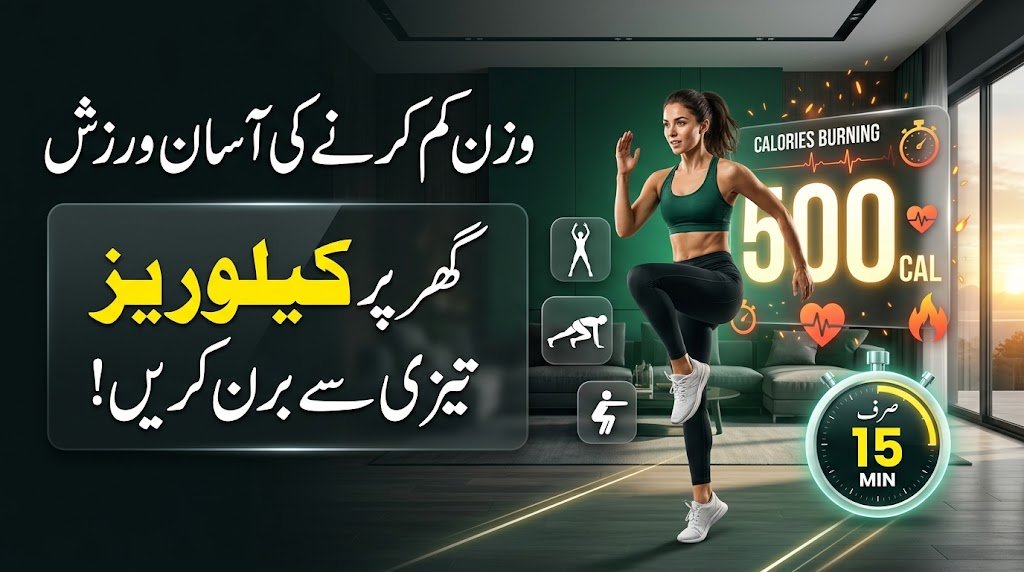
Losing weight does not necessarily require a gym membership or expensive equipment. A well-planned home workout for weight loss can raise your heart rate, strengthen major muscle groups, increase daily calorie expenditure, and help you build a routine that is easier to maintain.
The key is consistency. Exercises such as squats, jumping jacks, mountain climbers, high knees, lunges, push-ups, and brisk indoor walking can be combined into an effective workout at home.
For adults, health guidelines recommend at least 150 minutes of moderate-intensity aerobic activity each week, along with muscle-strengthening activities on at least two days. People trying to lose weight may need additional activity and may also need to adjust their food intake.
Quick Answer: What Is the Best Home Workout for Weight Loss?
There is no single exercise that guarantees the fastest weight loss. A practical home routine combines cardio, bodyweight strength exercises, and regular movement.
A simple beginner session could include:
- 3–5 minutes of warm-up
- 30 seconds of jumping jacks
- 30 seconds of bodyweight squats
- 30 seconds of high knees
- 30 seconds of mountain climbers
- 30 seconds of rest
- 30 seconds of alternating lunges
- 30 seconds of push-ups
- 30 seconds of marching or walking in place
- 1–2 minutes of recovery
Repeat the circuit according to your fitness level rather than trying to exercise at maximum intensity from the beginning.
Why Home Workouts Can Help With Weight Loss
Your body uses energy during physical activity. Increasing movement can therefore increase the number of calories you use.
Weight management, however, is not determined by exercise alone. The CDC explains that physical activity combined with reducing calorie intake can create the calorie deficit associated with weight loss.
This is why an effective approach should include:
Regular exercise + sensible eating habits + adequate recovery + consistency
Home workouts have another advantage: convenience. You can exercise without traveling to a gym, and even shorter activity sessions can contribute toward your weekly movement goal. Adults can divide their activity into smaller periods throughout the week.
10 Easy Home Exercises to Burn Calories
1. Jumping Jacks
Jumping jacks are a simple way to increase your heart rate and get your entire body moving.
How to do them:
- Stand upright with your feet together.
- Keep your arms beside your body.
- Jump while moving your feet outward.
- Raise your arms overhead.
- Return to the starting position.
Try 20–30 seconds initially.
If jumping is uncomfortable, step one foot outward at a time while moving your arms instead.
2. Bodyweight Squats
Squats target the legs and hips while using your core to stabilize your body.
How to perform a squat:
- Stand with your feet approximately shoulder-width apart.
- Push your hips backward.
- Bend your knees while keeping your chest comfortably upright.
- Lower only as far as you can control.
- Push through your feet to return to standing.
Start with 8–15 repetitions.
Squats are particularly useful in a home strength routine because they require no equipment.
3. High Knees
High knees provide a convenient cardio movement that can be performed in a small space.
Stand tall and alternate lifting your knees while moving your arms naturally. Begin slowly, then increase your pace if the movement feels comfortable.
For beginners, marching with moderately raised knees is a useful lower-impact alternative.
4. Mountain Climbers
Mountain climbers combine a plank position with alternating knee movements.
Place your hands beneath your shoulders and extend your legs behind you. Keep your body controlled while bringing one knee toward your chest, returning it, and switching sides.
Because the movement can become demanding quickly, beginners should prioritize good form over speed.
5. Reverse Lunges
Reverse lunges work the lower body and can be easier to control than faster jumping movements.
From a standing position:
- Step one foot backward.
- Lower your body in a controlled manner.
- Push through the front foot.
- Return to standing.
- Switch legs.
Perform 8–12 repetitions per side, depending on your fitness level.
6. Push-Ups
Push-ups strengthen the chest, shoulders, arms, and core.
If a traditional push-up is difficult, start with an easier variation, such as:
- Wall push-ups
- Incline push-ups
- Knee push-ups
As your strength improves, you can gradually work toward a standard push-up.
Bodyweight exercises such as push-ups count as muscle-strengthening activities.
7. Glute Bridges
Glute bridges are a useful floor exercise for strengthening the hips and glutes.
Lie on your back with your knees bent and feet positioned on the floor. Tighten your abdominal muscles, lift your hips in a controlled manner, pause briefly, and lower them.
Try 10–15 repetitions.
8. Step-Ups
If you have a stable, secure step that is suitable for exercise, step-ups can add cardio and lower-body work to your routine.
Step onto the platform with control, bring the other foot up, and step down safely. Alternate the leading leg.
Do not use an unstable chair or unsuitable household furniture.
9. Marching in Place
Marching is one of the simplest ways to start moving at home.
Stand upright and alternate lifting your feet while swinging your arms. Gradually increase the pace if comfortable.
It can also be used as a recovery movement between more challenging exercises.
10. Dancing
You do not need a formal workout routine every time you want to become more active.
Dancing at home can provide moderate physical activity while making exercise feel less repetitive. The CDC lists dancing among examples of moderate physical activity.
Choose movements you enjoy and keep the intensity appropriate for your fitness level.
A Simple 20-Minute Home Workout for Weight Loss
If you are short on time, try this structure.
| Exercise | Time |
|---|---|
| March in place | 2 minutes |
| Jumping jacks or step jacks | 30 seconds |
| Bodyweight squats | 30 seconds |
| High knees or marching | 30 seconds |
| Push-ups | 30 seconds |
| Reverse lunges | 30 seconds |
| Mountain climbers | 30 seconds |
| Rest | 60 seconds |
| Repeat circuit | 2–3 rounds |
| Cool-down | 2–3 minutes |
Important: The exact number of calories burned will vary considerably according to body size, exercise intensity, fitness level, and other factors. Calorie estimates from generic workout charts should therefore be treated as approximations rather than promises.
Beginner Home Workout Plan
If you are new to exercise, there is no need to start with an intense routine.
Week 1
Focus on learning the movements and building consistency.
3 days:
- 5-minute warm-up
- 10–15 minutes of easy exercise
- 3–5 minutes of cool-down
Week 2
Gradually increase the duration.
3–4 days:
- 5-minute warm-up
- 15–20 minutes of exercise
- 3–5 minutes of cool-down
Week 3 and beyond
As your fitness improves, gradually increase either the duration or intensity.
Do not increase everything at once.
The CDC recommends building activity gradually and emphasizes that some physical activity is better than none.
How Often Should You Exercise at Home to Lose Weight?
For general health, adults should aim for at least:
150 minutes of moderate-intensity aerobic activity per week
or
75 minutes of vigorous-intensity aerobic activity per week
along with muscle-strengthening activity on at least two days each week.
That could look like:
- Monday — Home cardio + strength
- Tuesday — Brisk walk or light movement
- Wednesday — Home workout
- Thursday — Easy activity
- Friday — Home cardio + strength
- Saturday — Walking, dancing, or another enjoyable activity
- Sunday — Recovery or gentle movement
You can adjust this schedule according to your fitness, responsibilities, and recovery needs.
Can You Lose Weight With Home Workouts Without Equipment?
Yes, it is possible to become more physically active without gym equipment.
Bodyweight movements can provide resistance training, while walking, dancing, marching, step-ups, and suitable cardio exercises can increase aerobic activity.
You do not need expensive equipment to begin.
A small amount of floor space and comfortable clothing may be enough for many beginner exercises.
The bigger challenge is usually maintaining the habit.
How to Burn More Calories During a Home Workout
Instead of searching for a “magic” calorie-burning exercise, focus on improving the overall quality of your routine.
1. Reduce unnecessary rest
Shorter recovery periods can make a workout more demanding, but beginners should still rest when necessary.
2. Use full-body movements
Exercises involving multiple muscle groups can make efficient use of limited workout time.
3. Increase duration gradually
Once a workout becomes comfortable, add a few minutes rather than suddenly doubling your exercise time.
4. Move more outside workouts
Walking around the house, taking stairs when appropriate, doing household tasks, and reducing long periods of sitting can add more movement to your day.
5. Make consistency the priority
A moderate routine you perform regularly can be more practical than an extremely difficult workout that you abandon after a few days.
Home Cardio vs. Strength Training for Weight Loss
Both can have a place in a weight-management routine.
Cardio exercises increase breathing and heart rate and can help you accumulate aerobic activity.
Examples include:
- Brisk walking
- Dancing
- Marching
- Jogging
- Jumping exercises
Strength exercises challenge muscles through resistance.
Examples include:
- Squats
- Lunges
- Push-ups
- Glute bridges
- Resistance-band exercises
The CDC recommends combining aerobic activity with muscle-strengthening work rather than relying on only one type of movement.
Does Exercise Alone Make You Lose Weight?
Not necessarily.
Exercise increases energy expenditure, but food and drink intake also influence your overall calorie balance. The CDC notes that people can remain physically active and still gain weight if they consume more calories than they use.
For sustainable weight management, consider the bigger picture:
- Choose nutritious foods most of the time.
- Pay attention to portions.
- Drink enough water.
- Limit frequent high-calorie drinks and snacks.
- Stay physically active.
- Get adequate sleep.
- Manage stress.
- Set realistic goals.
Healthy weight loss is generally approached gradually rather than through extreme short-term restrictions.
How Long Does It Take to See Results?
There is no universal timeline.
Results depend on factors including starting weight, food intake, activity level, sleep, age, genetics, medications, and health conditions.
Instead of judging progress solely by the scale, you can also monitor:
- Workout consistency
- Exercise duration
- Strength improvements
- Walking distance
- Energy levels
- Waist measurements
- How comfortably your clothes fit
A realistic approach is more sustainable than trying to achieve dramatic changes within a few days.
Mistakes to Avoid During Home Workouts
Doing Too Much Too Soon
Starting with an extremely demanding routine can make recovery difficult and may discourage you from continuing.
Ignoring Technique
Fast repetitions are not automatically better. Controlled movement should come before speed.
Skipping the Warm-Up
Spend a few minutes gradually preparing your body before more demanding movements.
Exercising Through Sharp Pain
Normal exertion and muscle fatigue are different from sharp or unusual pain. Stop an exercise that causes concerning pain.
Expecting Spot Reduction
Exercises cannot reliably force your body to lose fat from one specific area. Overall fat loss depends on the broader energy balance and individual factors.
Focusing Only on the Scale
Weight can fluctuate for many reasons. Look at longer-term trends and other signs of progress.
How to Make Home Exercise Easier to Stick With
The best workout is often one you can realistically continue.
Try these simple strategies:
Choose a fixed time.
A regular schedule makes exercise easier to remember.
Start small.
Even a short session can help you establish the habit.
Choose exercises you enjoy.
Walking, dancing, bodyweight training, or a combination may work better than forcing yourself to do an activity you dislike.
Track your sessions.
A simple calendar can show how consistently you are moving.
Increase gradually.
When a routine becomes comfortable, add a little more time or difficulty.
The CDC recommends setting specific and realistic short-term goals rather than relying on vague goals such as simply “exercise more.”
Safety Tips Before Starting a Weight-Loss Workout
If you have been inactive, start at a manageable intensity and progress gradually.
People with chronic health conditions or disabilities may benefit from discussing appropriate types and amounts of physical activity with a healthcare professional.
Also:
- Use a clear, non-slip exercise area.
- Wear comfortable footwear when appropriate.
- Keep water available.
- Learn the correct technique for each movement.
- Stop if you feel unwell.
- Avoid unstable furniture for step exercises.
- Give your body adequate recovery.
If you experience severe symptoms such as chest pain, fainting, or significant difficulty breathing during exercise, seek appropriate medical attention.
Frequently Asked Questions
What is the easiest home exercise for weight loss?
Brisk walking, marching in place, dancing, and beginner bodyweight exercises are among the easiest options to start with. The right choice depends on your current fitness and mobility.
What exercise burns the most calories at home?
Higher-intensity movements generally require more energy than low-intensity movements, but the actual calorie expenditure varies from person to person. Running, vigorous aerobic movements, and jumping exercises can be demanding, while brisk walking and dancing can provide more moderate options.
Can I lose belly fat with home workouts?
Home workouts can contribute to overall weight loss, but you cannot reliably choose where your body loses fat first. Combining regular activity with appropriate eating habits is a more realistic approach.
Is 20 minutes of home exercise enough?
Twenty minutes is a useful starting point, especially if you are currently inactive. Over time, you can build toward the recommended weekly amount of physical activity.
Can I lose weight without going to the gym?
Yes. Walking, bodyweight exercises, dancing, and other forms of physical activity can be performed without a gym membership.
How many days a week should I work out?
There is no single schedule for everyone. For general adult health, the target is at least 150 minutes of moderate activity each week plus muscle-strengthening activity on two or more days.
Final Takeaway
A home workout for weight loss does not need to be complicated. Start with movements you can perform safely, combine cardio with strength exercises, increase your activity gradually, and focus on consistency.
The goal should not be to complete the hardest workout possible. It should be to create a routine that you can repeat week after week.